08/20/2020
The Resilient City: Rethinking Urban Development
On Monday, August 24, 2020, Mario Reale will discuss the future of the city at the Immobilienforum Düsseldorf. In advance, he shares what makes city planning future-proof, how a resilient city can look, and what makes public spaces sustainable. Enjoy reading!
Public Space in the City Is More Than Just Buildings and Streets
Public space affects us as people and makes a city livable—or not. Mario Reale writes in this article about what makes city planning future-proof, what a resilient city can look like, and what makes public space sustainable.
Why Public Space in the City Is So Important
Sustainable urban development largely occurs through the design of public space. This includes a wide variety of characteristics and spatial conditions. What they share is unrestricted accessibility for all city residents and visitors and the freedom to make use of this space.
For me, public space is the place perceived by every city resident, where everyone moves. It is, for me, the democratic space in a just city, where each individual can freely develop their abilities. Therefore, these spaces—such as streets, alleys, squares, promenades, parks, and canals—must be livable, flexible, and open to multiple uses. When planning and building, the human being should always be at the center, with all their needs and expectations.
Only then can urban space become a meeting place and venue for social interaction, as well as a place for relaxation and retreat. What opportunities, then, arise to strengthen public space and make our cities more sustainable?
How Buildings Affect Public Space
Every building impacts urban space, so buildings must function not just on the street but in the broader context of the city. A space’s qualities are experienced through movement—it must be traversed to be fully perceived.
Urban spaces, such as streets and squares, flow almost seamlessly into one another, creating a continuous dynamic sequence of spaces formed by buildings, streets, and squares. Understanding the interaction of a building within the street and the street within the city is fundamental to sustainable urban planning. Therefore, it is essential not to consider a building in isolation but in the context of the entire urban environment. The quality of space beside and behind a building is just as important as its front.
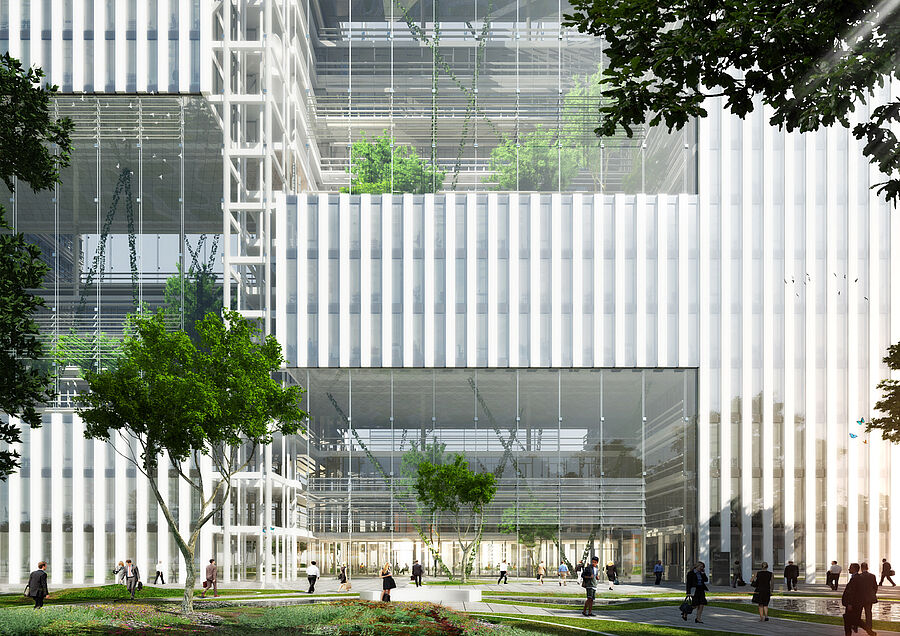
At Harkortstraße near Düsseldorf Central Station, we have planned three hotels with ground-floor gastronomy and a new publicly accessible pedestrian path from Konrad-Adenauer-Platz to Mintropplatz. The interplay of the different building forms, as well as the choice and arrangement of materials, creates diversity within unity, designed to be experienced from all sides. The previously unused potential of the site is thus activated, giving the city and its residents a new high-quality quarter that generates positive impacts in the surrounding area. A holistic view of the planned building as a direct response to its site and context is therefore essential for the functioning of a city.
More information about the project can be found here.
What Makes a Resilient City
Only when urban development is based on public space can a city be resilient and future-ready. A resilient city considers public space holistically, sustainably, and future-oriented, combining characteristics such as robustness, flexibility, and adaptability. Ensuring a livable future requires contemporary, consistently sustainable, and architecturally sophisticated construction. Sustainability, in turn, has significant economic and ecological value for both today’s and future society. Implementing these goals requires visionary collaboration between politics, city administration, and architects.
It takes courage!
My wish is to raise awareness of public space and make it a central urban issue, considered holistically. Public space is essential for enabling societal participation and adaptability to meet the new challenges of a city in constant change. Therefore, I hope that over time, viewers and users will develop sensitivity toward public space. Architects, urban planners, developers, administration, and politics must naturally understand that public space should not be a “leftover” area that buildings do not occupy but should be actively and consciously designed as a dynamic spatial sequence within a constantly evolving city.
This article was written for the Management Circle blog on March 5, 2020. A link can be found here.